When it comes to commercial roofing, the quality of a silicone roof coating isn’t determined by appearance alone. It’s determined by how well it bonds to the existing roof system. One of the most effective ways to verify that bond is through a pull test, also known as an adhesion test, which helps ensure the coating will perform as expected for years to come. For building owners and facility managers throughout Los Angeles and Orange County, understanding how this simple yet critical quality-control procedure works can provide confidence that their roof restoration investment is built to last.



4 Questions Every Building Owner Should Ask About Silicone Roof Coating Pull Tests
What is a pull test?
A small metal dolly (usually 20 mm or 50 mm in diameter) is glued to the cured silicone coating using a high-strength epoxy.
After the adhesive cures:
- The coating around the dolly is usually cut through to isolate the test area.
- A hydraulic or mechanical pull tester is attached.
- The tester pulls straight upward until something fails.
The gauge measures the force required to pull the coating away from the roof, typically reported in:
- PSI (pounds per square inch)
- MPa (megapascals)
What are you looking for?
Interestingly, the number isn’t always the most important part.
What’s even more important is how it failed.
There are several possible failure modes:
Cohesive failure (best outcome)
The silicone tears within itself while remaining bonded to the roof.
This means:
- Excellent adhesion
- The coating itself was weaker than the bond
.
Substrate failure (also excellent)
The coating stays attached, but part of the roof surface comes off with it (for example, weathered asphalt or insulation facer).
This generally means the bond exceeded the strength of the substrate.
Adhesive failure (bad)
The silicone cleanly separates from the roof surface.
This indicates poor adhesion and often points to:
- Dirty surface
- Moisture contamination
- Improper primer
- Incorrect preparation
- Incompatible existing coating
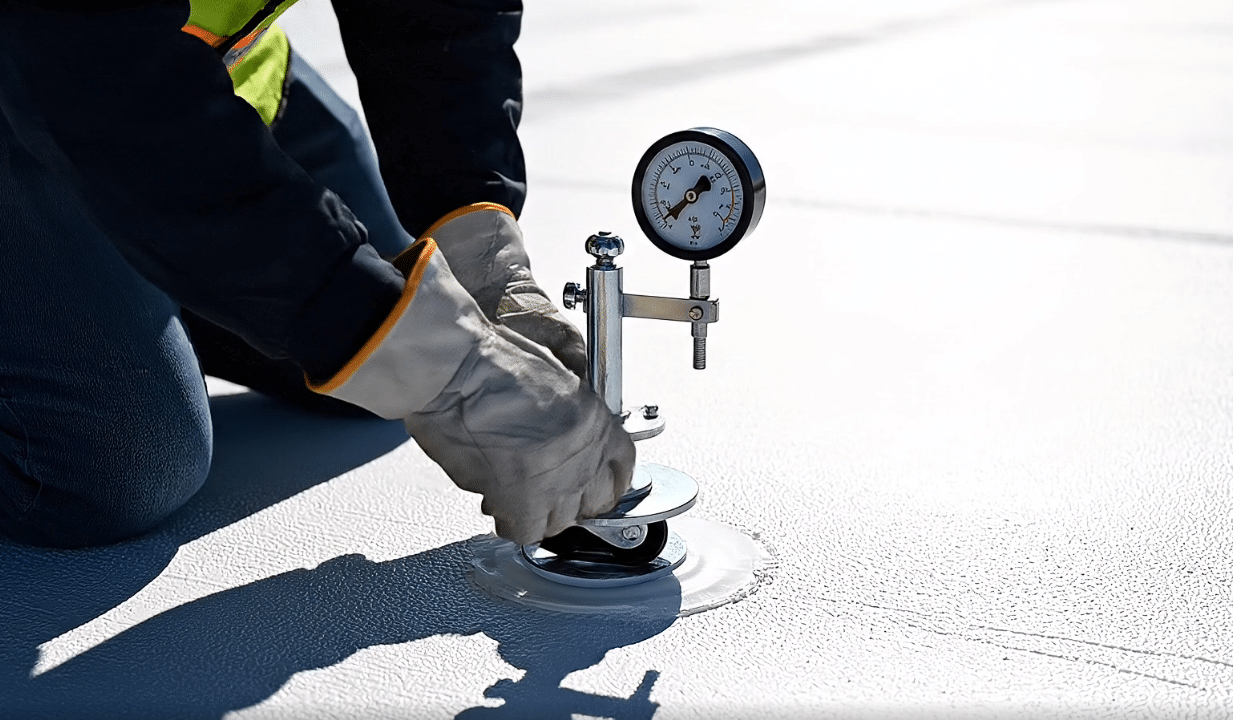
What equipment is used?
Common instruments include:
- DeFelsko PosiTest AT
- Elcometer adhesion testers
- Proceq pull-off testers
These are commonly used by:
- Roofing consultants
- Manufacturers
- Quality control inspectors
- Warranty inspectors
When is a pull test performed?
A contractor or consultant may perform one:
- Before coating an older roof to determine whether the existing surface is suitable.
- After applying a coating to verify it achieved the manufacturer’s required adhesion.
- During warranty inspections.
- When investigating coating failures such as peeling or delamination.
Typical acceptable values
Every manufacturer has its own specifications because different substrates behave differently.
Examples might include:
- Smooth BUR
- Modified bitumen
- TPO (often requires a primer)
- Metal roofs
- Spray polyurethane foam
On some roofs, 20–30 PSI may be acceptable, while others may require 50 PSI or more. Manufacturers also care greatly about the failure mode, not just the PSI reading.
Why this matters for commercial roofing
If you’re applying a 20-year silicone restoration system, a pull test gives confidence that the coating will remain bonded through:
- Thermal expansion and contraction
- UV exposure
- Ponding water
- Wind uplift
It’s one of the strongest quality-control tools available before issuing a long-term warranty.
FAQ: Silicone Roof Coating Pull Tests
1. What is a pull test, and why does it matter for silicone roof coatings?
A pull test measures how well a silicone roof coating has bonded to the substrate beneath it. A technician adheres a small test disc to the coating, then uses a calibrated gauge to measure the force required to pull it free. The result tells you whether the coating has achieved proper adhesion or is at risk of peeling, blistering, or failing early — which matters most for commercial roofing assets where a coating failure can mean water intrusion into inventory, equipment, or occupied space below.
2. How often should pull tests be performed on a commercial roof coating?
Most manufacturers and applicators recommend a pull test before the topcoat is applied (to confirm the primer or existing membrane is sound) and again after cure, before the project is signed off. For buildings in coastal or high-UV climates — common across Los Angeles and Orange County — an annual spot check as part of a roof maintenance plan is a smart way to catch adhesion loss before it turns into a leak.
3. Who should conduct roof coating pull tests — can I do it myself?
Pull tests require a calibrated adhesion tester and an understanding of substrate types, so this isn’t a DIY step. A licensed commercial roofing contractor will know where on the roof field to sample, how to interpret the pounds-per-square-inch reading against the coating manufacturer’s minimum threshold, and how to document results for warranty purposes. If you’re unsure whether your building’s coating has been tested, request a free assessment and ask specifically about adhesion testing.
4. What happens if a roof coating fails a pull test?
A failed pull test means the coating isn’t bonded well enough to perform as designed, and it should be addressed before the project is closed out or before it’s relied on for another season. Depending on the cause, the fix may be re-priming and recoating the affected area, or in some cases restarting the section entirely. This is also why warranty terms matter: ask your contractor how failed adhesion is handled under the roof’s warranty coverage before work begins.
Let’s Fix Your Roof Right — Get a Free Estimate Today
Serving Los Angeles & Orange County for 30+ years.
Trusted. Local. Professional.
Central Roofing Company Headquarters
555 W. 182nd Street
Gardena, CA 90248
📞 310-527-6770
Get A Quote
Serving Southern California
Central Roofing provides commercial roofing services across Los Angeles County, Orange County, San Bernardino County, and Riverside County — including repairs, coatings, maintenance, re-roofing, and emergency leak response.
555 W. 182nd St. Gardena, CA 90248
Ph: 310-527-6770
Our Office Locations:
 Services
Our Services
CA license #684960 – Central Roofing, 2026 ©All Rights Reserved | Terms of Use | Privacy Policy | Built by Dymic


